Skin & tanning · Evidence tier A
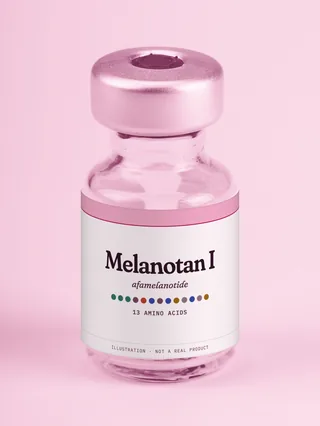
Melanotan I (afamelanotide)
Afamelanotide · Scenesse (brand name) · Melanotan 1 · MT-1 · MT1 · MT-I
Melanotan I is afamelanotide, approved as Scenesse, an implant for a rare disorder that makes sunlight painful12. Small trials found it darkens skin34, but ‘MT1’ vials sold online for tanning are not approved56.
Quick answers
- What is it?
- A lab-made version of the hormone that tells skin to make pigment12. As afamelanotide, it is the drug in Scenesse, a slow-release implant1. Online sellers offer it as ‘MT1’ vials for tanning6.
- Does it work?
- For tanning, small placebo-controlled trials found it darkened skin, most in fair skin that burns easily34. For the rare light disorder, implants added some pain-free time in sunlight2. We found no trial of online vials.
- Is it safe?
- Implant trials found mostly mild side effects, like nausea12. Serious allergic reactions have been reported since approval1. It darkens moles, and FDA required at least 8 years of skin cancer follow-up17. A tanning-bed user who injected online melanotan developed five early melanomas; cause is unproven8.
What it is
Melanotan I (MT-I) is afamelanotide; FDA’s review lists Melanotan, Melanotan-1 (MT-1), CUV1647 and EPT1647 as code names for the drug in Scenesse15. It is a chain of 13 amino acids modeled on alpha-melanocyte-stimulating hormone (alpha-MSH), the body’s own signal for making eumelanin, the brown-black skin pigment12. Two swaps make it last far longer than the natural hormone: norleucine replaces methionine at position 4, and D-phenylalanine, the mirror-image form of phenylalanine, replaces the usual form at position 716. In the 1980 lab study that described it, it resisted breakdown by enzymes in blood serum and was 26 times as potent as alpha-MSH in a test on mouse melanoma cells16. It binds mainly to MC1R, the melanocortin 1 receptor on pigment cells, and makes the skin produce more of that pigment without sunlight or UV light12. A 2026 case report contrasts it with melanotan II: melanotan I mainly targets MC1R, while melanotan II acts on several receptors, with wider effects that include sexual function and appetite8.
Sawyer and colleagues described the molecule in 1980 as a version of alpha-MSH with ‘ultralong biological activity’16. Researchers later named it melanotan I and tested it for tanning, while its ring-shaped cousin, melanotan II, was tested for erectile dysfunction and led to PT-14117. A placebo-controlled tanning trial appeared in JAMA in 19913, and later studies ran at dermatology clinics in Tucson, Arizona18. Melbourne-based Clinuvel developed it as CUV1647 and sponsored the trials in erythropoietic protoporphyria (EPP) that led to its approvals151920. The EU authorized Scenesse on 22 December 2014, the US approved it on 8 October 2019, Clinuvel announced Australian approval in October 2020, and Health Canada approved it on 9 July 20265212223.
Benefits: what the research shows
The strongest evidence is for the approved use, erythropoietic protoporphyria (EPP). In two randomized, double-blind, placebo-controlled Phase 3 trials, a 16 mg implant every 60 days increased the time patients could spend in direct sunlight without pain215. In the US trial (94 patients, three implants), the median was 69.4 hours over 6 months versus 40.8 on placebo (P=0.04); in the European trial (74 patients, five implants), it was 6.0 versus 0.8 hours over 9 months (P=0.005), with fewer painful reactions (77 vs 146)2. The margins were thin. FDA’s reanalysis of the US trial, counting every randomized patient, gave a p-value of 0.055, just above the usual 0.05 cutoff, and a third trial of 77 patients (CUV030) missed its main goals15. FDA still judged the drug effective, and the European Medicines Agency’s experts called the extra time in sunlight small but recommended approval, citing possible quality-of-life gains, the unmet need and mild side effects1524. An earlier open-label study of two 20 mg implants in 5 patients found better tolerance of a standard light test25. In an uncontrolled study of 115 patients treated for up to 8 years in Rome and Zurich, quality-of-life scores rose from 31% to 74% of the maximum26. For tanning, the evidence is small and old, and it comes from near-daily injections dosed by body weight, not from the products sold online. In a 1991 randomized, double-blind trial in 28 white men, 10 injections over 12 days darkened skin in both poor and good tanners, with no darkening on placebo. All used a high-potency sunscreen, and the peak came 1 to 3 weeks after the last injection3. In a 2006 placebo-controlled trial, 65 fair-skinned volunteers completed three 10-day courses of 0.16 mg/kg over 3 months. Skin melanin rose 41% in those who burn easily and 12% in those who burn less easily, and in the burn-prone group, sunburn cells after a UV test fell by more than half4. The same trial found 59% less thymine dimer formation, a form of UV damage to DNA4. A placebo-controlled study of 77 white adults found larger melanin gains in people with MC1R gene variants, whom the authors call ‘most in need of photoprotection’27. In 7 volunteers, 10 injections raised eumelanin in forearm skin by 98%28. In small open-label studies, people tanning with sunlight alone needed 50% more sun time for the same tan as those also given the drug18. In vitiligo, adding a monthly implant to light therapy gave more repigmentation by day 168 (48.6% vs 33.3%), with the benefit seen in darker skin types (IV to VI) but not type III29. A Phase 3 vitiligo trial of 200 people was listed as active, not recruiting, on 7 October 202620. We found no trial of ‘MT1’ vials or of the doses described for them.
Key human studies
| Study | Design | People | Dose and route | Result |
|---|---|---|---|---|
| Langendonk et al., N Engl J Med 2015 (studies CUV039 and CUV029)2PubMed · DOI · NCT01605136 · NCT00979745 | Two multicenter, randomized, double-blind, placebo-controlled Phase 3 trials in adults with erythropoietic protoporphyria: US (180 days) and European Union (270 days) | 168 | 16 mg implant under the skin every 60 days: three implants (US) or five (EU) | Median hours in direct sunlight without pain: 69.4 vs 40.8 on placebo over 6 months (US, 94 patients; P=0.04) and 6.0 vs 0.8 over 9 months (EU, 74 patients; P=0.005). Phototoxic reactions 77 vs 146 (EU; P=0.04). Quality of life improved; adverse events mostly mild. |
| Levine et al., JAMA 19913PubMed | Randomized, placebo-controlled, double-blind trial in healthy white men with poor-tanning (types I to II) or good-tanning (types III to IV) skin; 7 weeks of follow-up | 28 | 10 injections under the skin over 12 days (dose not given in the abstract) vs saline | Significant skin darkening in both skin-type groups (P<.001); none on placebo. Changes peaked 1 to 3 weeks after the last injection. All subjects used a high-potency sunscreen. |
| Barnetson et al., J Invest Dermatol 20064PubMed · DOI | Placebo-controlled trial in fair-skinned white volunteers; 65 completed | 65 | 0.16 mg/kg injected under the skin of the abdomen, three 10-day courses over 3 months | Melanin density rose 41% in skin that burns easily (low minimal erythemal dose) and 12% in skin that burns less easily (both P<0.0001 vs placebo). In burn-prone volunteers, sunburn cells after a UV test fell by more than 50%; thymine dimers fell 59% (P=0.002). |
| FDA review of NDA 210797, 2019 (study CUV030)15NCT01097044 | Randomized, double-blind, placebo-controlled trial in US adults with erythropoietic protoporphyria; Phase 3 in FDA’s review, Phase 2 in the registry | 77 | 16 mg implant under the skin every 2 months | Negative: no statistically significant effect on its prespecified endpoints, the severity of phototoxic reactions. Pain-free sunlight endpoints were defined after the fact, so FDA did not count them as evidence of efficacy. |
| Lim et al., JAMA Dermatol 201529PubMed · DOI · NCT01430195 | Randomized multicenter trial in adults with nonsegmental vitiligo, skin types III to VI; implant plus narrowband UV-B light therapy vs light therapy alone; not blinded per the registry | 55 | 16 mg implant under the skin monthly for 4 months, after 1 month of light therapy | Repigmentation 48.64% vs 33.26% at day 168; earlier repigmentation of the face (41 vs 61 days) and upper limbs (46 vs 69 days). Gains in skin types IV to VI, not type III. Minor infections and nausea in the combination group. |
| Fitzgerald et al., Peptides 200627PubMed · DOI | Placebo-controlled study in white adults, comparing people with and without MC1R gene variants | 77 | Dose and route not given in the abstract | Melanin density rose significantly vs placebo (p<0.001), and more in carriers of six MC1R variants than in non-carriers. |
Doses studied
Doses below are what studies used or what a label says. They are not advice, and gray-market products may not contain what their label says.
In human studies
Approved US label: one 16 mg implant placed under the skin above the front of the hip bone (anterior supra-iliac crest) every 2 months1. EU label: one implant every 2 months before and during times of increased sun exposure, with the length of treatment left to the specialist21. FDA’s review describes a maximum of five implants a year15. The pivotal trials gave three implants (US) or five (EU), 60 days apart2. Tanning studies used injections under the skin dosed by body weight: 0.08 or 0.16 mg/kg a day for 10 days18, and 0.16 mg/kg in three 10-day courses over 3 months4. A 3-man comparison gave ten doses of 0.08 to 0.21 mg/kg under the skin, and 0.16 mg/kg by vein or by mouth38. The vitiligo trial gave a 16 mg implant monthly for 4 months29. We found no human study of the fixed microgram doses described for online vials.
In animal studies
Pregnant rats given 0.2, 2 or 20 mg/kg/day under the skin during organ formation showed no harm to the developing young, and fertility was unaffected at up to 20 mg/kg/day1. In a 90-day study, rats got 0.2, 2 or 20 mg/kg under the skin once a day; FDA reviewers set the no-observed-adverse-effect level at 2 mg/kg/day15. FDA noted that no accurate animal model exists to test whether it could cause melanoma15.
What users report Anecdotal · not validated · not a recommendation
One community site lists 250 µg (micrograms) per dose, injected two days a week39.
- Half-life
- About 30 minutes; the implant releases most of it within 48 hours21The EU product information adds that over 90% has left the implant by day 521. The US label instead gives an apparent half-life of about 15 hours for the slow-release implant, with blood levels peaking at a median of 36 hours1. In 3 men given injections under the skin, the elimination half-life was 0.8 to 1.7 hours38.
- Routes
- Implant under the skin (Scenesse): the approved form, tested in large controlled trials
- Injection under the skin: used in the tanning trials, and how online vials are used
- Intravenous: one small study in 3 men
- By mouth: no drug reached the blood in that study
Every dose studied for Melanotan I (afamelanotide), with sources →
Legal status
- United States
- Afamelanotide is FDA-approved only as Scenesse (NDA 210797), a 16 mg implant approved on 8 October 2019 as a new molecular entity, with priority review and orphan-drug status57. It is approved to increase pain-free light exposure in adults with a history of phototoxic reactions from erythropoietic protoporphyria (EPP)7. The label says a health care professional trained by Clinuvel should place the implant1. FDA held no advisory committee meeting and did not require a REMS, a formal risk-management program15. On 12 August 2024 FDA approved a change to the label’s contraindications after a 2022 safety-signal letter; the 2019 label listed none3334. Vials sold online as ‘Melanotan I’ or ‘MT1’ are a separate, unapproved product6. FDA’s Import Alert 66-41 lets agents detain ‘Melanotan (I and II)’ without examining it, under entries dating from 9 April 20109.
- US pharmacies
- Neither afamelanotide nor melanotan appears in any category of FDA’s 503A bulk-substance list (updated 14 May 2026) or its 503B list (updated 21 March 2025)3031. A 503A pharmacy may compound with a bulk ingredient that meets a USP or NF monograph, is a component of an FDA-approved drug, or appears on FDA’s 503A bulks list10. Because Scenesse is FDA-approved, afamelanotide may qualify as a component of an approved drug. That is our inference from the rule, not an FDA statement, and it does not cover research-chemical vials510.
- Other countries
- EU: Scenesse was authorized on 22 December 2014 to prevent phototoxicity in adults with EPP, under ‘exceptional circumstances’ because the disease is too rare for complete data21. Only specialists in recognized porphyria centers may prescribe it21. Its EU orphan status ended in December 2024, when its 10 years of market exclusivity ran out24. Australia: afamelanotide is a Schedule 4 (prescription-only) substance in the Poisons Standard in force from 1 October 2026. The index lists ‘melanotan I’ and ‘melanocyte stimulating hormone’ as cross-references, and it is not in Appendix D11. Clinuvel announced on 27 October 2020 that Australia’s Therapeutic Goods Administration had approved Scenesse for EPP22. Canada: Health Canada’s drug database lists Scenesse (DIN 02569825) as approved on 9 July 20262335, and afamelanotide joined the Prescription Drug List effective 27 August 202636. Health Canada names melanotan I among unauthorized injectable peptides it has seized1437. UK and other countries: not verified.
- Sport
- Neither afamelanotide nor melanotan I is named on the 2026 Prohibited List or on the 2027 List, which takes effect on 1 January 20271232. Class S0 bans substances with no current government approval for human therapeutic use; afamelanotide is approved in the US and the EU, so by our reading it falls outside S051221. The 2027 List adds ‘peptides’ to the S0 examples but keeps the same approval test32.
Quality and the gray market
What testing finds
We found no independent test results. Finnrick, a testing service, showed ‘No published Melanotan I tests yet’ on 7 October 202613. Health Canada warns that unauthorized drugs may ‘contain too much, too little, or none of the active ingredient’ or contaminants such as solvents, heavy metals and microbes14. By contrast, each approved Scenesse implant is a dissolvable rod about 1.7 cm long that holds 16 mg of afamelanotide1.
How it is sold
Online retailers sell it as ‘MT1’ or ‘Melanotan I’ and label it for research use only640. GQ reported on 12 August 2026 that some people choose MT1 over melanotan II because it darkens skin without raising libido or curbing appetite, and that a 10 mg vial or nasal spray of either costs roughly $406. On 7 October 2026 it was the first peptide on one vendor’s shop page sorted by popularity, at $4540. A 2018 study that surveyed users on an online melanotan forum describes both melanotans as easy to buy illicitly online and injected under the skin for tanning41. FDA has listed melanotan products in Import Alert 66-41 since 20109.
Side effects and risks
- Darker moles and freckles: the US label says it can darken existing moles and freckles and advises a full skin exam twice a year1. In 15 patients with implants, mole changes seen under a dermatoscope reversed within a year, with no signs of cancer and no new moles42.
- Melanoma: unproven but not ruled out. No cancer studies were done in animals, no accurate animal model exists, and FDA required at least 8 years of skin cancer follow-up, with a final report due in March 20311715. A 2026 case report described five early melanomas in a tanning-bed user who had injected online melanotan II and then melanotan I; the authors say one case cannot establish cause8. A 2017 review counted four earlier reports of melanoma during or soon after melanotan use43.
- Allergic reactions: serious reactions, including anaphylaxis, have been reported since approval, and the US label now rules out use after a severe allergic reaction to it133. The EU added an anaphylaxis warning in 2026 and advises watching patients for 30 minutes after each implant2144.
- Common side effects of the implant: reactions where it was placed (21% vs 10% on placebo), nausea (19% vs 14%), throat pain, cough, tiredness, dizziness and skin darkening1. Tanning studies with injections reported nausea and brief facial flushing1838.
- Not a sunscreen: even in the approved use, the label tells patients to keep up sun and light protection during treatment1.
- Unknown contents: no independent tests of ‘MT1’ vials were found, and Health Canada warns that unauthorized products may hold the wrong amount of drug or contaminants1314.
- Untested groups: the US label says there are no data on use in pregnancy and that safety and effectiveness in children have not been established1. The EU label rules it out with severe liver disease or liver or kidney impairment, advises against use over age 70, asks women who could become pregnant to use contraception during treatment and for 3 months after, and notes that trials lasted no longer than 2 years21.
- Legal risk: selling it for human use is illegal in the US and Canada, and Health Canada has seized it61437.
Documented harms
- 8 Oct 2019In European post-approval safety studies reviewed for the US approval, Clinuvel reported 21 allergy and hypersensitivity reactions, involving 1.6% of Scenesse administrations; none had been seen in the trials15.
- 12 Aug 2024FDA approved a change to the US label’s contraindications after a 2022 safety-signal letter; the original 2019 label listed none3334. The current label rules out use after a severe allergic reaction to afamelanotide and reports serious allergic reactions, including anaphylaxis, since approval1.
- 23 Apr 2026The European Commission approved an update to the EU product information that adds a warning on allergic reactions and lists anaphylaxis as an uncommon side effect, based on postmarketing data and medical literature44.
- 12 May 2026A case report described a 49-year-old man with fair skin who developed five melanomas in situ, an early stage confined to the top layer of skin. He had recently used tanning beds, injected melanotan II bought online and then melanotan I, and taken testosterone from an unregulated online source. The authors say one case cannot establish cause8.
Questions people ask
Is melanotan 1 the same as afamelanotide?
Yes, by name: FDA’s review lists Melanotan, Melanotan-1 (MT-1) and CUV1647 as code names for afamelanotide, the drug in the Scenesse implant15. Vials sold online as ‘MT1’ are not Scenesse, and no independent tests of their contents were found13.
Is melanotan 1 FDA approved?
Only as Scenesse, a 16 mg implant approved on 8 October 2019 for adults with erythropoietic protoporphyria (EPP)57. Vials sold for tanning are unapproved, and FDA can detain them at import9.
Does melanotan 1 work for tanning?
In small placebo-controlled trials, near-daily injections darkened skin, most in fair skin that burns easily34. Those studies used doses based on body weight, and none tested online vials4.
Is melanotan 1 safer than melanotan 2?
Melanotan I mainly targets the skin’s pigment receptor, while melanotan II acts more widely and also affects sexual function and appetite8. As Scenesse, melanotan I has safety data from three controlled trials, in which 125 people got the implant, and from approved use since 2014121. That record does not cover online vials, whose contents are unknown13.
Can melanotan 1 cause moles or melanoma?
It can darken existing moles and freckles, and the US label advises a full skin exam twice a year1. Whether it raises melanoma risk is unknown: FDA required at least 8 years of skin cancer follow-up, and a 2026 case report of melanomas in a melanotan user could not establish cause78.
What is Scenesse used for?
It is approved to increase pain-free light exposure in adults with erythropoietic protoporphyria (EPP), an inherited disorder in which sunlight causes severe pain2726. A trained health care professional places one implant under the skin every 2 months1.
Is melanotan 1 legal in Australia?
Afamelanotide, which the Poisons Standard index also lists as melanotan I, is a Schedule 4 (prescription-only) substance in the standard in force from 1 October 202611. Clinuvel announced in October 2020 that Australia’s medicines regulator had approved Scenesse for EPP22.
What is still unknown
- Melanoma risk: no animal cancer studies were done, and FDA’s required follow-up of patients for at least 8 years is not due to report final results until March 2031.
- Effects of the doses described for online vials: we found no human study of fixed microgram doses, or of injections repeated over months or years.
- What ‘MT1’ vials contain: no independent test results were found as of 7 October 2026.
- The US trial’s size and result differ between sources: 94 patients randomized (NEJM paper, FDA review) vs 93 enrolled (US label, registry), and median pain-free hours of 69.4 vs 40.8 (NEJM paper, EU label) vs 64.1 vs 40.5 (US label). The European trial’s placebo median is 0.8 hours in the paper and 0.75 in the US label.
- Half-life figures differ: about 30 minutes in the EU label, an apparent 15 hours for the implant in the US label, and 0.8 to 1.7 hours after injection in a 1997 study. The sources do not reconcile them.
- Implant limits differ: FDA’s review describes at most five a year, the EMA’s public overview says at most four, and the current EU product information sets no maximum.
- Results of the Phase 3 vitiligo trial NCT06109649 (200 participants): still listed as active, not recruiting, on 7 October 2026, with a completion date of June 2026.
- Australia: we could not open the Therapeutic Goods Administration’s register entry or public assessment report; the 2020 approval comes from Clinuvel’s announcement.
- A 2011 case letter, ‘Pseudoleucoderma after injections of afamelanotide in a patient with atopic dermatitis’, could be read only by its title.
- How many people use melanotan I for tanning, and at what doses: we found no usage figures.
- UK and other countries’ rules were not verified, and FDA has not said whether US pharmacies may compound afamelanotide.
Sources
- 1SCENESSE (afamelanotide) implant prescribing information Clinuvel via DailyMed (U.S. National Library of Medicine), 11 May 2026. dailymed.nlm.nih.gov
- 2Afamelanotide for Erythropoietic Protoporphyria New England Journal of Medicine, 2 Jul 2015. pubmed.ncbi.nlm.nih.gov
- 3Induction of skin tanning by subcutaneous administration of a potent synthetic melanotropin JAMA, 20 Nov 1991. pubmed.ncbi.nlm.nih.gov
- 4[Nle4-D-Phe7]-alpha-melanocyte-stimulating hormone significantly increased pigmentation and decreased UV damage in fair-skinned Caucasian volunteers Journal of Investigative Dermatology, Aug 2006. pubmed.ncbi.nlm.nih.gov
- 5Drugs@FDA: NDA 210797, Scenesse (afamelanotide) U.S. Food and Drug Administration (Drugs@FDA), accessed 7 Oct 2026. accessdata.fda.gov
- 6Inside the Weird New World of Peptide Tanning GQ, 12 Aug 2026. gq.com
- 7Approval letter for NDA 210797, Scenesse (afamelanotide) implant U.S. Food and Drug Administration, 8 Oct 2019. accessdata.fda.gov
- 8Five primary melanomas in situ in a patient with recent tanning bed use, melanotan exposure, and anabolic hormone use JAAD Case Reports, Jul 2026. pubmed.ncbi.nlm.nih.gov
- 9Import Alert 66-41: Detention Without Physical Examination of Unapproved New Drugs Promoted In The U.S. U.S. Food and Drug Administration, 1 Oct 2026. accessdata.fda.gov
- 10Bulk Drug Substances Used in Compounding Under Section 503A of the FD&C Act U.S. Food and Drug Administration, 14 May 2026. fda.gov
- 11Therapeutic Goods (Poisons Standard—October 2026) Instrument 2026 (F2026L01327) Federal Register of Legislation, Australian Government, 28 Sep 2026. legislation.gov.au
- 12World Anti-Doping Code International Standard: Prohibited List 2026 World Anti-Doping Agency, 24 Sep 2025. wada-ama.org
- 13Melanotan I Safety Testing Results & Vendor Ratings Finnrick, accessed 7 Oct 2026. finnrick.com
- 14Think twice before injecting peptides bought online: unauthorized products can seriously harm you (RA-81874) Health Canada, 9 Apr 2026. recalls-rappels.canada.ca
- 15NDA 210797 Multi-discipline Review and Evaluation (Scenesse, afamelanotide) U.S. Food and Drug Administration, CDER, 8 Oct 2019. accessdata.fda.gov
- 164-Norleucine, 7-D-phenylalanine-alpha-melanocyte-stimulating hormone: a highly potent alpha-melanotropin with ultralong biological activity Proceedings of the National Academy of Sciences, Oct 1980. pubmed.ncbi.nlm.nih.gov
- 17Melanocortin peptide therapeutics: historical milestones, clinical studies and commercialization Peptides, Apr 2006. pubmed.ncbi.nlm.nih.gov
- 18Effects of a superpotent melanotropic peptide in combination with solar UV radiation on tanning of the skin in human volunteers Archives of Dermatology, Jul 2004. pubmed.ncbi.nlm.nih.gov
- 19SCENESSE® approved for EPP in Canada (ASX announcement) Clinuvel Pharmaceuticals, 13 Jul 2026. clinuvel.com
- 20ClinicalTrials.gov search: studies with the intervention afamelanotide (23 records) ClinicalTrials.gov, accessed 7 Oct 2026. clinicaltrials.gov
- 21Scenesse: EPAR product information European Medicines Agency, 7 Oct 2026. ema.europa.eu
- 22Australian TGA approves SCENESSE® Clinuvel Pharmaceuticals, 27 Oct 2020. clinuvel.com
- 23Drug Product Database: SCENESSE (DIN 02569825) product record Health Canada, accessed 7 Oct 2026. health-products.canada.ca
- 24Scenesse: EPAR medicine overview European Medicines Agency, 30 Jan 2026. ema.europa.eu
- 25Mitigating photosensitivity of erythropoietic protoporphyria patients by an agonistic analog of alpha-melanocyte stimulating hormone Photochemistry and Photobiology, Nov 2009. pubmed.ncbi.nlm.nih.gov
- 26Long-term observational study of afamelanotide in 115 patients with erythropoietic protoporphyria British Journal of Dermatology, Jun 2015. pubmed.ncbi.nlm.nih.gov
- 27Effect of MELANOTAN, [Nle(4), D-Phe(7)]-alpha-MSH, on melanin synthesis in humans with MC1R variant alleles Peptides, Feb 2006. pubmed.ncbi.nlm.nih.gov
- 28Increased eumelanin expression and tanning is induced by a superpotent melanotropin [Nle4-D-Phe7]-alpha-MSH in humans Photochemistry and Photobiology, Oct 2000. pubmed.ncbi.nlm.nih.gov
- 29Afamelanotide and narrowband UV-B phototherapy for the treatment of vitiligo: a randomized multicenter trial JAMA Dermatology, Jan 2015. pubmed.ncbi.nlm.nih.gov
- 30Bulk Drug Substances Nominated for Use in Compounding Under Section 503A of the Federal Food, Drug, and Cosmetic Act (categories list) U.S. Food and Drug Administration, 14 May 2026. fda.gov
- 31Bulk Drug Substances Nominated for Use in Compounding Under Section 503B of the Federal Food, Drug, and Cosmetic Act (categories list) U.S. Food and Drug Administration, 21 Mar 2025. fda.gov
- 32World Anti-Doping Code International Standard: Prohibited List 2027 World Anti-Doping Agency, 21 Sep 2026. wada-ama.org
- 33Supplement approval letter, NDA 210797/S-007 (Scenesse) U.S. Food and Drug Administration, 12 Aug 2024. accessdata.fda.gov
- 34SCENESSE prescribing information, original approval label (Revised 10/2019) U.S. Food and Drug Administration (Drugs@FDA), Oct 2019. accessdata.fda.gov
- 35Drug Product Database API: active ingredient search for afamelanotide Health Canada, accessed 7 Oct 2026. health-products.canada.ca · data query
- 36Prescription Drug List: Human Use Health Canada (Drug and Health Product Register), accessed 7 Oct 2026. hpr-rps.hres.ca
- 37Unauthorized injectable peptide drugs seized and sold by Canada Peptide may pose serious health risks (RA-77807) Health Canada, 1 Aug 2025. recalls-rappels.canada.ca
- 38Skin pigmentation and pharmacokinetics of melanotan-I in humans Biopharmaceutics & Drug Disposition, Apr 1997. pubmed.ncbi.nlm.nih.gov
- 39Melanotan I: How It Works, Mechanism & Evidence (2026) The Peptide Catalog, 18 Apr 2026. thepeptidecatalog.com
- 40Prime Peptides shop page sorted by popularity Prime Peptides (vendor), accessed 7 Oct 2026. primepeptides.co (seller page, deliberately not linked)
- 41A glimpse into the underground market of melanotan Dermatology Online Journal, 15 May 2018. pubmed.ncbi.nlm.nih.gov
- 42Clinical and dermoscopic changes of acquired melanocytic nevi of patients treated with afamelanotide Photochemical & Photobiological Sciences, Feb 2021. pubmed.ncbi.nlm.nih.gov
- 43Risks of unregulated use of alpha-melanocyte-stimulating hormone analogues: a review International Journal of Dermatology, Oct 2017. pubmed.ncbi.nlm.nih.gov
- 44Scenesse: EPAR procedural steps taken and scientific information after authorisation European Medicines Agency, 7 Oct 2026. ema.europa.eu
Not medical advice. This page reports what studies and regulators say; it does not recommend using any product. How we grade evidence · Report an error.