Longevity & wellness · Evidence tier B
SS-31 (elamipretide)
elamipretide · Forzinity (US brand name) · elamipretide hydrochloride (the salt form in Forzinity) · MTP-131 (development code) · Bendavia (earlier formulation name) · Ocuvia (earlier formulation name)
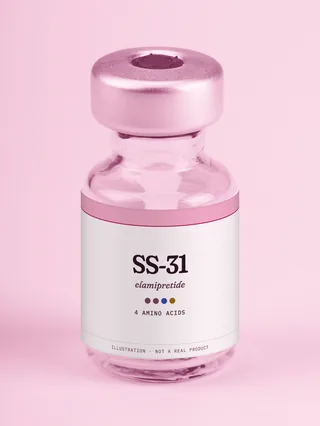
SS-31 is elamipretide, a lab-made peptide aimed at mitochondria, the cell’s power plants. FDA approved it in 2025 as Forzinity for a rare genetic disease123. Most trials missed their main goals, and ‘SS-31’ vials sold online are not approved4567.
Quick answers
- What is it?
- SS-31 is the research code for elamipretide, a lab-made peptide that collects in mitochondria, the parts of cells that make energy128. As Forzinity, it is a prescription injection for Barth syndrome, a rare inherited disease23. Unapproved ‘SS-31’ vials are also sold online7.
- Does it work?
- Not clearly. FDA approved it for Barth syndrome based on leg-strength gains seen without a placebo group, and a new trial must confirm a benefit239. A large trial in inherited mitochondrial muscle disease failed5. One drip in older adults did not clearly improve muscle endurance10.
- Is it safe?
- Mostly well tolerated in trials, but injection-site redness, pain and itching are very common256. Serious allergic reactions have occurred2. Cancer risk is unknown, and FDA required new animal cancer studies311. No registered trial has tested months of use in healthy people12.
What it is
Elamipretide is a lab-made peptide made of four amino acids2. It was designed to collect on the inner membrane of mitochondria, the structures that make most of a cell’s energy8. It binds cardiolipin, a fat found only in that membrane, which explains why it gathers there8. The Forzinity label calls it ‘a mitochondrial cardiolipin binder that localizes to the inner mitochondrial membrane and improves mitochondrial morphology and function’2. Barth syndrome, the disease it is approved for, comes from defects in a gene called TAZ that leave cardiolipin abnormal4. The disease causes exercise intolerance, muscle weakness, fatigue, heart failure, repeated infections and slow growth21. FDA reviewers noted that elamipretide does not fix the underlying genetic defect or meaningfully change the raised cardiolipin ratio seen in the disease9.
SS-31 is one of the Szeto–Schiller (SS) peptides, which their inventors found by chance while working on an opioid peptide, according to a 2014 review co-written by one of them; SS-31 was designed to target mitochondria while barely binding opioid receptors8. A company, Stealth Peptides of Newton, Massachusetts, took it into human testing in 2010 as an acetate salt called MTP-1318. Its formulations were earlier called Bendavia and Ocuvia, and the generic name elamipretide was adopted in 201622. Stealth BioTherapeutics filed for US approval on 19 August 2021, and FDA approved Forzinity on 19 September 2025923. On 16 June 2026 the company announced it would now operate as Mighty Therapeutics24.
Benefits: what the research shows
Forzinity’s approval rests on one small trial. In TAZPOWER, 12 patients with Barth syndrome aged 12 or older took 40 mg a day and placebo for 12 weeks each, in random order; neither main goal, the 6-minute walk test and a symptom score, was met4. Knee strength did not rise in that randomized part, but in the open-label extension, where everyone took the drug, median strength rose by 34 to 68 newtons from a baseline of 1242. Walking distance improved by 96 meters at week 168 in the 8 patients who stayed25. FDA’s clinical and statistical reviewers and their team leader concluded the data were not substantial evidence of effectiveness and recommended that FDA not approve it, but the official who signed the decision accepted the uncertainty for a very rare, serious disease and treated knee strength as reasonably likely to predict real benefit9. FDA requires a placebo-controlled trial to confirm the benefit3. The company’s 4TAZPower trial dosed its first patient in July 2026 and plans to enroll about 48 males aged 5 to 55 for 72 weeks2627. In primary mitochondrial myopathy, a group of inherited muscle diseases, the 218-person MMPOWER-3 trial found no benefit after 24 weeks: walking distance differed from placebo by -3.2 meters (p=0.69), and fatigue did not improve5. An earlier 4-week crossover trial in 30 people found a 19.8-meter difference that was not statistically significant, though participants reported less fatigue28. A post hoc analysis of MMPOWER-3 found a trend toward benefit (p=0.06) in people with variants in genes that maintain mitochondrial DNA, mostly POLG and TWNK29. The follow-up trial, NuPower (102 people, 60 mg a day for 48 weeks), was completed in 2024, but its efficacy results have not been posted30; the company says they support further work in POLG disease and that it will propose a new pivotal trial3132. FDA’s review reported its safety results: injection-site redness in 51% on elamipretide against 8% on placebo, and 7 serious adverse events against 1, none judged related to the drug by the investigators or the company9. One person on elamipretide died of cardiac arrest, which the reviewers wrote was more likely related to underlying medical conditions than to the drug9. Other programs have mostly missed their main goals. In dry age-related macular degeneration, ReCLAIM-2 (176 people, 48 weeks of daily 40 mg injections) missed both main goals but reported slower loss of the ellipsoid zone, a retinal layer that reflects the health of light-sensing cells, on secondary measures with nominal p-values6. The company started a two-trial Phase 3 program, ReNEW and ReGAIN, in 202433; ReNEW (313 people, 96 weeks) is expected to read out in late 20273435. In 12 people with Leber hereditary optic neuropathy, an inherited eye disease, 1% eye drops did not improve visual acuity more than a dummy solution36. In heart disease, a drip given during angioplasty for a heart attack, from shortly before the procedure until 1 hour after blood flow was restored, did not shrink heart damage in about 300 patients, and the trial’s registry lists 10 deaths among 150 people on the drug against 3 among 147 on placebo3738, and 4 weeks of daily injections did not improve heart pumping in 71 people with heart failure39; in a 36-person study, one 4-hour drip at the highest dose reduced heart volumes at the end of the infusion40. For aging, the one placebo-controlled trial with published results that we found is MOTION1012. In it, 39 healthy adults aged 60 to 85 with poorly working muscle mitochondria received one 2-hour drip or placebo. Right after the drip, the maximum rate of energy production in a hand muscle rose by a borderline margin (p=0.055; p=0.045 as a percentage change), with no difference 7 days later10. Fatigue resistance in that muscle did not improve in the analysis the protocol set out; analyses added afterward, which included tests 1 and 7 days later or counted contractions instead, found a significant difference10. A 4-week pilot without a placebo group, giving daily injections to adults aged 65 to 80, is still recruiting41. A 2026 XPRIZE Healthspan milestone award to the company and a University of Washington team was premised on pilot data in older adults that we did not find published; the company says those data will inform the design of a larger controlled trial, which we did not find registered1242. In old mice, one dose quickly restored muscle energy measures and 8 days of treatment increased endurance43; 8 weeks of treatment improved heart relaxation44 and slowed frailty without measurable changes in markers of biological age45.
Key human studies
| Study | Design | People | Dose and route | Result |
|---|---|---|---|---|
| Reid Thompson et al., Genet Med 2021 (TAZPOWER)4PubMed · DOI · NCT03098797 | Phase 2/3 randomized, double-blind, placebo-controlled crossover trial (12 weeks per period, 4-week washout), then an open-label extension; patients with Barth syndrome aged 12 or older and over 30 kg | 12 | 40 mg subcutaneous injection once daily | Randomized part: neither main goal (6-minute walk, symptom score) was met, and knee strength did not rise. Open-label extension: 6-minute walk +95.9 m at 36 weeks (p=0.024) and +96.1 m at 168 weeks in 8 patients (p=0.003)25; median knee strength +34 to +68 newtons2. |
| Karaa et al., Neurology 2023 (MMPOWER-3)5PubMed · DOI · NCT03323749 | Phase 3 randomized, double-blind, placebo-controlled trial, 24 weeks; adults with genetically confirmed primary mitochondrial myopathy | 218 | 40 mg subcutaneous injection once daily | Missed both main goals: 6-minute walk -3.2 m vs placebo (95% CI -18.7 to 12.3; p=0.69); total fatigue score p=0.37. Well tolerated, with most adverse events mild to moderate. |
| Roshanravan et al., PLoS One 2021 (MOTION)10PubMed · DOI · NCT02245620 | Phase 2 randomized, double-blind, placebo-controlled trial of a single dose; healthy adults aged 60 to 85 selected for poorly functioning muscle mitochondria | 39 | 0.25 mg/kg/hour intravenous infusion for 2 hours, once | Maximum mitochondrial energy production in a hand muscle rose right after the infusion vs placebo (p=0.055; p=0.045 for percent change), with no difference at day 7. Fatigue resistance did not improve in the protocol’s analysis; unplanned analyses adding the day 1 and day 7 tests (p<0.04) or counting contractions found a difference. No serious adverse events (0 of 19 vs 0 of 20)48. |
| Ehlers et al., Ophthalmol Sci 2025 (ReCLAIM-2)6PubMed · DOI · NCT03891875 | Phase 2 randomized, double-masked, placebo-controlled trial, 48 weeks; adults aged 55 or older with dry age-related macular degeneration and geographic atrophy | 176 | 40 mg subcutaneous injection once daily | Missed both main goals (low-light visual acuity and growth of the atrophy area). Secondary measures: 43% less progression of total ellipsoid zone loss (nominal p=0.0034) and 47% less partial loss (nominal p=0.0040); a gain of 10 letters or more in 14.6% vs 2.1% (nominal p=0.0404). Adverse events in 86% vs 71%, mostly injection-site reactions. |
| Butler et al., J Card Fail 2020 (PROGRESS-HF)39PubMed · DOI · NCT02788747 | Phase 2 randomized, double-blind, placebo-controlled trial, 4 weeks; heart failure with reduced ejection fraction (40% or less) | 71 | 4 mg or 40 mg subcutaneous injection once daily for 28 days | No improvement in left ventricular end-systolic volume vs placebo (40 mg: difference 2.3, 95% CI -1.9 to 6.5, p=0.28; 4 mg: -0.3, p=0.90) or in ejection fraction. Well tolerated. |
| Gibson et al., Eur Heart J 2016 (EMBRACE STEMI)37PubMed · DOI · NCT01572909 | Phase 2a randomized, double-blind, placebo-controlled trial; first anterior ST-elevation heart attack treated with primary angioplasty (PCI) | 300 | 0.05 mg/kg/hour intravenous infusion, from 15 to 60 minutes before angioplasty until 1 hour after blood flow was restored | Infarct size (CK-MB area under the curve over 72 hours) did not fall: 5570 vs 5785 ng·h/mL on placebo (not significant). No improvement in MRI, angiographic, ECG or clinical outcomes. The registry lists 300 enrolled; deaths in 10 of 150 vs 3 of 147 on placebo; and serious adverse events in 20 of 150 vs 14 of 147, including cardiogenic shock in 4 vs 0 and sudden cardiac death in 1 vs 038. |
Doses studied
Doses below are what studies used or what a label says. They are not advice, and gray-market products may not contain what their label says.
In human studies
Approved label: 40 mg injected under the skin once daily; 20 mg once daily for people with severely reduced kidney function (eGFR below 30) who are not on dialysis, with too little information for people on dialysis2. Controlled trials of daily injections mostly used 40 mg for 4 to 48 weeks45628; PROGRESS-HF compared 4 mg and 40 mg for 28 days39, and NuPower used 60 mg a day for 48 weeks30. Drips into a vein used 0.25 mg/kg/hour for 2 hours in MOTION10, 0.05 mg/kg/hour in EMBRACE STEMI, from 15 to 60 minutes before angioplasty until 1 hour after blood flow was restored38 and 0.005 to 0.25 mg/kg/hour for 4 hours in heart failure40. FDA’s review notes that multiple doses up to 80 mg a day have been tolerated9. The longest reported use is 168 weeks in 8 patients with Barth syndrome, 3 of whom reached 192 weeks2. In healthy people, only single doses and short safety studies have results; a 4-week pilot in older adults is still recruiting91041.
In animal studies
Old mice: one 3 mg/kg injection into the abdomen restored muscle energy measures within 1 hour, and 8 days of treatment increased endurance43. Old mice given 3 µg/g of body weight a day by a pump implanted under the skin for 8 weeks had better heart relaxation44, and another study gave 3 mg/kg a day by implanted pumps for 8 weeks45. Reproductive studies found no embryo-fetal toxicity at up to 10 mg/kg/day into a vein in rats and 50 mg/kg/day in rabbits, and no effect on rat fertility at up to 20 mg/kg/day under the skin2.
What users report Anecdotal · not validated · not a recommendation
A dosing-protocol website (updated 4 October 2026) lists 5 to 10 mg injected under the skin once a day, and up to 20 mg a day in an ‘advanced’ chart. The same page says a research vial is not interchangeable with the FDA-approved Forzinity58.
- Half-life
- about 1.5 to 4 hours9After a single 40 mg injection under the skin, the mean half-life was 3.2 hours in 32 healthy volunteers and 1.5 hours in 7 patients with Barth syndrome; after 7 daily doses it was 2.8 hours in 5 volunteers, and FDA’s summary table gives about 3 to 4 hours9. Blood levels peak 0.5 to 1 hour after an injection, and nearly all of a dose is recovered in the urine, as the drug or its breakdown products, within 48 hours2.
- Routes
- Subcutaneous injection: the approved Forzinity route; human data from early safety studies to large trials
- Intravenous infusion: single drips or short courses in heart, kidney-function and aging studies; human data
- Eye drops: three small trials, of 1% drops in Leber hereditary optic neuropathy, 1% and 3% drops in Fuchs’ corneal dystrophy, and low- and high-dose drops in diabetic macular edema and macular degeneration; the Leber trial found no benefit, and the other two posted no efficacy results
- By mouth: early safety and drug-level studies in healthy volunteers only
- Gray-market ‘SS-31’ is sold as freeze-dried powder in vials; we found no human data on these products
Legal status
- United States
- Elamipretide is FDA-approved only as Forzinity (NDA 215244), approved on 19 September 2025 as a new molecular entity23. The approved use is ‘to improve muscle strength in adult and pediatric patients with Barth syndrome weighing at least 30 kg’3. It is an accelerated approval: FDA may withdraw it if the required confirmatory trial fails to verify clinical benefit or is not run with due diligence3. FDA granted it orphan drug designation for Barth syndrome on 22 March 20189. In 2019 and 2020 FDA told the company that the randomized part of its Barth syndrome trial was negative and that the open-label results could not be interpreted without a control group9. The company applied anyway on 19 August 2021, and FDA refused to file the application on 18 October 20219. It resubmitted on 29 January 2024 without running the new trial FDA had recommended9. On 10 October 2024 an FDA advisory committee voted 10 to 6 that the available evidence showed elamipretide is effective for Barth syndrome9. On 15 May 2025 FDA declined to approve it in a complete response letter: it could not conclude that the data established effectiveness, but said knee strength could serve as an intermediate endpoint; it also called the cancer risk uncertain, flagged a possible interaction with drugs carried by the MATE1 transporter, and found deficiencies at the manufacturing facility11. After the company resubmitted, FDA’s clinical and statistical reviewers and their team leader recommended that FDA not approve it, but the official who signed the decision approved it, accepting more uncertainty than for common diseases because Barth syndrome is very rare (about 150 patients in the US), serious and had no approved treatment9. FDA also granted a rare pediatric disease priority review voucher3. Commercial supply became available in late November 202535, and on 30 April 2026 the company said 33 patients had started treatment32. ‘SS-31’ sold as a research chemical is a separate, unapproved product. On 24 August 2026 FDA warned four online sellers that the ‘SS-31’ they sold was an unapproved new drug7131415. One letter states that ‘research use only’ and ‘not for human consumption’ labels did not change that finding7.
- US pharmacies
- Elamipretide does not appear in any category of FDA’s 503A bulk-substance list (updated 14 May 2026) or its 503B list (updated 21 March 2025)4649. A 503A pharmacy may compound with a bulk ingredient that meets a USP monograph, is a component of an FDA-approved drug, or is on FDA’s 503A bulks list16. Because Forzinity is FDA-approved, elamipretide may qualify as a component of an approved drug. That is our inference from the rule, not an FDA statement, and it does not cover research-chemical vials1623.
- Other countries
- EU: no elamipretide medicine appears in the European Medicines Agency’s medicines data as of 7 October 202650. The EU granted orphan designations for Barth syndrome (20 May 2021) and for a muscle form of mitochondrial DNA depletion syndrome (16 May 2022); a designation does not mean the medicine is authorized5152. In 2023 the company licensed rights for Barth syndrome in Europe, the Middle East and North Africa to Pharmanovia53, and on 26 May 2026 it said no therapy for Barth syndrome is EMA-approved31. Canada: Health Canada’s Drug Product Database lists no elamipretide product54, and Health Canada named SS-31 among unauthorized injectable peptides it seized in warnings issued in 2025 and 2026555657. Australia: the Poisons Standard in force from 1 October 2026 does not name elamipretide or SS-3147. UK and other countries: not verified.
- Sport
- Not named on the 2026 Prohibited List, in force now, or on the 2027 List, published 21 September 2026 and in force from 1 January 20271718. Because elamipretide is approved for human use in the US, it falls outside S0, the catch-all ban on substances with no current approval for human therapeutic use, by our reading1723. Its labeled action, binding cardiolipin in mitochondria, is not one of the metabolic modulator groups named in class S4.4, such as AMPK activators (which include MOTS-c), by our reading217. The 2027 List adds ‘peptides’ to the S0 examples, which does not change this for an approved drug18.
Quality and the gray market
What testing finds
Independent data are limited. Finnrick, an independent testing service, reported 20 tests of gray-market SS-31 between 12 March 2026 and 17 September 2026: 12 passed, 5 failed and 3 were incomplete under its default standard (purity of at least 99.5% and content within 35% of the label)19. Finnrick tests samples for identity, purity and quantity20, and its SS-31 page shows no sterility or bacterial-toxin results19. Health Canada warns that unauthorized injectable peptides may contain too much, too little or none of the active ingredient, or contaminants such as solvents, heavy metals, particles or microbes57. Forzinity is a sterile, ready-to-use solution2; the gray-market product is a freeze-dried powder labeled for research only59.
How it is sold
‘SS-31’ is sold online as a ‘research use only’ freeze-dried powder, for example in 10 mg vials. On 7 October 2026 one vendor listed a 10 mg vial at $79.99, tenth of 41 products in its popularity-sorted list, and said its products are ‘Not for Human consumption of any kind’; such rankings are vendor-controlled59. FDA’s 24 August 2026 warning letters quote sellers promoting it for ‘Mitochondrial repair, anti-aging, neuroprotection’13, for ‘enhancing cellular energy production (ATP)’15 and as ‘a promising agent for treating liver inflammation’14. In 2025 Health Canada listed SS-31 among unauthorized injectable peptides seized from Canada Peptide, which sold them through its website, and among products seized at a Vancouver fitness business5556. Demand is small: in Finnrick’s data on more than 21,000 test requests, the mitochondrial group of MOTS-c, NAD+ and SS-31 made up about 2%. Finnrick counted SS-31 with unapproved products, noting that it is technically FDA-approved but used off-label in the gray market and too rarely requested to affect that split20.
Side effects and risks
- Injection-site reactions: in the Barth syndrome trial, all 12 patients had redness while on the drug, versus 3 of 12 on placebo; hardening and itching each affected 8 of 12 versus 2 of 12, pain 9 versus 5, and hives 3 versus 02. In the macular degeneration trial, adverse events, mostly injection-site reactions, affected 86% on the drug and 71% on placebo6.
- Allergic reactions: serious allergic reactions that needed emergency treatment have been reported, with signs such as rash, raised bumps, eczema-like skin inflammation and cough; they can start within minutes or months after treatment begins2.
- Benzyl alcohol: Forzinity contains this preservative and is not approved for newborns, because benzyl alcohol has caused serious, sometimes fatal reactions in premature and low-birth-weight babies2.
- Eosinophils, a type of white blood cell, often rose with use of 30 days or more, peaking around 90 days and returning to baseline after 6 to 12 months or after stopping; the rise was not linked to symptoms or to changes in other lab tests2.
- Cancer risk is unknown: the label states that no cancer studies have been done2, FDA called the human cancer potential uncertain11, and it required a 26-week mouse study and a 2-year rat study, with the rat report due in January 20303.
- Kidney function: drug exposure rises by 39% to 125% as kidney function falls from mild to severe impairment, and the label halves the dose for severe impairment without dialysis2.
- Drug interactions: in lab tests it blocks MATE1, a transporter that carries drugs such as the diabetes medicine metformin; FDA required a study of its effect on metformin, with the report due in September 20272311.
- Healthy people: no registered trial has tested months of daily use; MOTION gave a single drip, and a 4-week pilot in older adults is still recruiting101241.
- Self-chosen doses: an online dosing site describes 5 to 20 mg a day for up to 12 weeks58. No trial we found tested that pattern; controlled trials mostly used 40 mg a day in people with specific diseases456.
- Product quality: research vials have no FDA approval, so FDA has not reviewed their quality; in one service’s tests, 5 of 20 failed and 3 were incomplete719. Health Canada warns such products may contain too much, too little or none of the drug, or contaminants57.
- Legal risk: FDA treats ‘SS-31’ research vials as unapproved new drugs, and Health Canada has seized them756.
Documented harms
- Sep 2025The Forzinity label reports serious allergic reactions requiring emergency medical treatment in patients receiving the drug, starting anywhere from minutes to months after treatment began2.
- 9 Apr 2026Health Canada told consumers not to use unauthorized injectable peptides, listing SS-31 among products it had seized, and warned that such products may lead to infections, allergic reactions and other serious complications. The advisory reports no case of harm from SS-31 itself57.
- 30 Jul 2026FDA’s adverse event database (FAERS) held no report naming elamipretide or Forzinity. One serious report, received 16 December 2025, listed ‘SS31 (peptide)’ among products a patient was also taking; the suspected cause was a different medicine. Reports are unverified, and few reports do not prove a product is safe60.
Questions people ask
Is SS-31 the same as elamipretide?
Yes. SS-31 is the research code for elamipretide, which was also developed under the code MTP-13118. Forzinity is the FDA-approved product, a sterile 80 mg/mL solution, while ‘SS-31’ vials sold online are research chemicals that FDA treats as unapproved drugs27.
Is SS-31 FDA approved?
Only as Forzinity, approved on 19 September 2025 to improve muscle strength in people with Barth syndrome who weigh at least 30 kg323. It is an accelerated approval that depends on a confirmatory trial3. ‘SS-31’ research vials are not approved for any use7.
Does SS-31 work for anti-aging?
There is no good evidence in people. In the one placebo-controlled trial we found in healthy older adults, a single drip briefly raised a lab measure of muscle energy by a borderline margin, and muscle endurance improved only in analyses added afterward10. Results in old mice were more positive, and a 4-week pilot in older adults is still recruiting414345.
What are the side effects of SS-31?
Injection-site reactions such as redness, itching, hardening and pain are very common26. Serious allergic reactions and rises in eosinophils, a type of white blood cell, have been reported2. Its cancer risk has not been settled11.
SS-31 vs MOTS-c: what’s the difference?
Both are sold for ‘mitochondrial energy’, but they are different molecules. SS-31 is a four-amino-acid lab-made peptide that binds cardiolipin in mitochondria and is approved in the US as Forzinity for Barth syndrome23. MOTS-c is named on the anti-doping Prohibited List as an activator of AMPK, an energy-sensing enzyme; SS-31 is not17.
What is still unknown
- Whether the benefit in Barth syndrome is confirmed: the 4TAZPower trial (NCT07531251) lists a primary completion date of 30 September 2029.
- NuPower’s efficacy results (NCT05162768, completed 4 December 2024) have not been posted on ClinicalTrials.gov or published in a journal, as far as we found; FDA’s review reported only its safety results.
- ReNEW (NCT06373731) in dry macular degeneration is expected to read out in late 2027; its companion trial ReGAIN could not be found on ClinicalTrials.gov.
- Results of the 4-week pilot in adults aged 65 to 80 (NCT07275424) and of the pilot behind the 2026 XPRIZE award are unpublished; whether they are the same study was not verified.
- The larger controlled trial in older adults that the XPRIZE pilot data are meant to inform was not registered on ClinicalTrials.gov as of 7 October 2026.
- The 26-week mouse cancer study report FDA required was due in February 2026 and has not been made public, as far as we found; the 2-year rat study report is due in January 2030.
- Two heart-failure trials (NCT02814097 and NCT02914665) completed years ago without posting results.
- What gray-market ‘SS-31’ vials contain beyond 20 tests by one service; no sterility or bacterial-toxin results were found.
- Effects in healthy people of the 5 to 20 mg daily courses described online. We found no study of them.
- Approval status in the UK and other countries was not verified.
- Whether FDA accepts 503A compounding of elamipretide as a component of an approved drug; FDA has not addressed it.
Sources
- 1Elamipretide (CID 11764719) PubChem, NCBI, accessed 7 Oct 2026. pubchem.ncbi.nlm.nih.gov
- 2FORZINITY (elamipretide) injection prescribing information Stealth BioTherapeutics via DailyMed (U.S. National Library of Medicine), 10 Dec 2025. dailymed.nlm.nih.gov
- 3Approval letter for NDA 215244, Forzinity (elamipretide) injection U.S. Food and Drug Administration, 19 Sep 2025. accessdata.fda.gov
- 4A phase 2/3 randomized clinical trial followed by an open-label extension to evaluate the effectiveness of elamipretide in Barth syndrome, a genetic disorder of mitochondrial cardiolipin metabolism Genetics in Medicine, Mar 2021. pubmed.ncbi.nlm.nih.gov
- 5Efficacy and Safety of Elamipretide in Individuals With Primary Mitochondrial Myopathy: The MMPOWER-3 Randomized Clinical Trial Neurology, 18 Jul 2023. pubmed.ncbi.nlm.nih.gov
- 6ReCLAIM-2: A Randomized Phase II Clinical Trial Evaluating Elamipretide in Age-related Macular Degeneration, Geographic Atrophy Growth, Visual Function, and Ellipsoid Zone Preservation Ophthalmology Science, Jan 2025. pubmed.ncbi.nlm.nih.gov
- 7Warning letter to Peak Performance Peptides (MARCS-CMS 735127) U.S. Food and Drug Administration, 24 Aug 2026. fda.gov
- 8Serendipity and the discovery of novel compounds that restore mitochondrial plasticity Clinical Pharmacology & Therapeutics, Dec 2014. pmc.ncbi.nlm.nih.gov
- 9NDA 215244 Integrated Review (Forzinity, elamipretide) U.S. Food and Drug Administration, CDER, 19 Sep 2025. accessdata.fda.gov
- 10In vivo mitochondrial ATP production is improved in older adult skeletal muscle after a single dose of elamipretide in a randomized trial PLOS ONE, 2021. pmc.ncbi.nlm.nih.gov
- 11Complete response letter for NDA 215244 (elamipretide), in Other Action Letters U.S. Food and Drug Administration, 15 May 2025. accessdata.fda.gov
- 12ClinicalTrials.gov search: elamipretide, SS-31, MTP-131 or Bendavia (32 records, 30 of them elamipretide studies) ClinicalTrials.gov, accessed 7 Oct 2026. clinicaltrials.gov
- 13Warning letter to Royal Peptides LLC (MARCS-CMS 734884) U.S. Food and Drug Administration, 24 Aug 2026. fda.gov
- 14Warning letter to Peptide Partners LLC (MARCS-CMS 735063) U.S. Food and Drug Administration, 24 Aug 2026. fda.gov
- 15Warning letter to TXP Innovations LLC dba Tex Peptides (MARCS-CMS 735067) U.S. Food and Drug Administration, 24 Aug 2026. fda.gov
- 16Bulk Drug Substances Used in Compounding Under Section 503A of the FD&C Act U.S. Food and Drug Administration, 14 May 2026. fda.gov
- 17World Anti-Doping Code International Standard: Prohibited List 2026 World Anti-Doping Agency, 24 Sep 2025. wada-ama.org
- 18World Anti-Doping Code International Standard: Prohibited List 2027 World Anti-Doping Agency, 21 Sep 2026. wada-ama.org
- 19SS-31: safety testing results and vendor ratings Finnrick, 17 Sep 2026. finnrick.com
- 20We’d Rather Buy the Future Than Wait For It Finnrick, 10 Jun 2026. finnrick.com
- 21Stealth BioTherapeutics Announces FDA Accelerated Approval of FORZINITY™ (elamipretide) injection, the First Therapy for Progressive and Life-limiting Ultra-rare Genetic Disease Barth Syndrome Stealth BioTherapeutics (Mighty Therapeutics website), 19 Sep 2025. mightytx.com
- 22What’s in a Name? The Root of Elamipretide Stealth BioTherapeutics (Mighty Therapeutics website), 5 May 2016. mightytx.com
- 23Drugs@FDA record for NDA 215244 (Forzinity), openFDA drugsfda endpoint U.S. Food and Drug Administration (openFDA), 6 Oct 2026. api.fda.gov · data query
- 24Mighty Therapeutics, Formerly Stealth BioTherapeutics, Announces New Name Honoring the Mitochondrial Disease Community Mighty Therapeutics, 16 Jun 2026. mightytx.com
- 25Long-term efficacy and safety of elamipretide in patients with Barth syndrome: 168-week open-label extension results of TAZPOWER Genetics in Medicine, Jul 2024. pubmed.ncbi.nlm.nih.gov
- 26Mighty Therapeutics Announces First Patient Dosed in Phase 4 Confirmatory Study of Elamipretide in Barth Syndrome Mighty Therapeutics, 8 Jul 2026. mightytx.com
- 27Clinical Trial in Patients With Barth Syndrome- 4TAZPower (NCT07531251) ClinicalTrials.gov, 17 Sep 2026. clinicaltrials.gov
- 28A randomized crossover trial of elamipretide in adults with primary mitochondrial myopathy Journal of Cachexia, Sarcopenia and Muscle, Aug 2020. pubmed.ncbi.nlm.nih.gov
- 29Genotype-specific effects of elamipretide in patients with primary mitochondrial myopathy: a post hoc analysis of the MMPOWER-3 trial Orphanet Journal of Rare Diseases, 21 Nov 2024. pubmed.ncbi.nlm.nih.gov
- 30Study to Evaluate Efficacy and Safety of Elamipretide in Subjects With Primary Mitochondrial Disease From Nuclear DNA Mutations (nPMD) (NCT05162768) ClinicalTrials.gov, 24 Oct 2025. clinicaltrials.gov
- 31Stealth BioTherapeutics to Present Updates on Elamipretide in Barth Syndrome and POLG Disease at Euromit 2026 Stealth BioTherapeutics (Mighty Therapeutics website), 26 May 2026. mightytx.com
- 32Stealth BioTherapeutics Provides Commercial Launch Update and Pipeline Progress Across Mitochondrial Disease Portfolio Stealth BioTherapeutics (Mighty Therapeutics website), 30 Apr 2026. mightytx.com
- 33Stealth BioTherapeutics Announces First Patient Enrolled in Global Phase 3 Clinical Program for Elamipretide in Patients with Dry Age-Related Macular Degeneration Stealth BioTherapeutics (Mighty Therapeutics website), 5 Jun 2024. mightytx.com
- 34ReNEW:Phase 3 Study of Efficacy, Safety & Pharmacokinetics of Subcutaneous Injections of Elamipretide in Subjects With Dry Age-Related Macular Degeneration (Dry AMD) (NCT06373731) ClinicalTrials.gov, 17 Sep 2026. clinicaltrials.gov
- 35Stealth BioTherapeutics Provides Commercial and R&D Pipeline Update and Outlines 2026 Strategic Priorities Stealth BioTherapeutics (Mighty Therapeutics website), 6 Jan 2026. mightytx.com
- 36Elamipretide Topical Ophthalmic Solution for the Treatment of Subjects with Leber Hereditary Optic Neuropathy: A Randomized Trial Ophthalmology, Apr 2024. pubmed.ncbi.nlm.nih.gov
- 37EMBRACE STEMI study: a Phase 2a trial to evaluate the safety, tolerability, and efficacy of intravenous MTP-131 on reperfusion injury in patients undergoing primary percutaneous coronary intervention European Heart Journal, 21 Apr 2016. pubmed.ncbi.nlm.nih.gov
- 38Evaluation of Myocardial Effects of MTP-131 for Reducing Reperfusion Injury in Patients With Acute Coronary Events (NCT01572909) ClinicalTrials.gov, 11 Jun 2020. clinicaltrials.gov
- 39Effects of Elamipretide on Left Ventricular Function in Patients With Heart Failure With Reduced Ejection Fraction: The PROGRESS-HF Phase 2 Trial Journal of Cardiac Failure, May 2020. pubmed.ncbi.nlm.nih.gov
- 40Novel Mitochondria-Targeting Peptide in Heart Failure Treatment: A Randomized, Placebo-Controlled Trial of Elamipretide Circulation: Heart Failure, Dec 2017. pubmed.ncbi.nlm.nih.gov
- 41Study of Healthy Aging and Physical Function With Elamipretide (NCT07275424) ClinicalTrials.gov, 10 Dec 2025. clinicaltrials.gov
- 42Mighty Therapeutics and University of Washington Team Named Milestone 2 Awardee in $101M XPRIZE Healthspan Competition Mighty Therapeutics, 11 Aug 2026. mightytx.com
- 43Mitochondrial-targeted peptide rapidly improves mitochondrial energetics and skeletal muscle performance in aged mice Aging Cell, Oct 2013. pubmed.ncbi.nlm.nih.gov
- 44Late-life restoration of mitochondrial function reverses cardiac dysfunction in old mice eLife, 10 Jul 2020. pmc.ncbi.nlm.nih.gov
- 45The Mitochondria-Targeted Peptide Therapeutic Elamipretide Improves Cardiac and Skeletal Muscle Function During Aging Without Detectable Changes in Tissue Epigenetic or Transcriptomic Age Aging Cell, Jun 2025. pmc.ncbi.nlm.nih.gov
- 46Bulk Drug Substances Nominated for Use in Compounding Under Section 503A of the Federal Food, Drug, and Cosmetic Act (categories list) U.S. Food and Drug Administration, 14 May 2026. fda.gov
- 47Therapeutic Goods (Poisons Standard—October 2026) Instrument 2026 (F2026L01327) Federal Register of Legislation, Australian Government, 28 Sep 2026. legislation.gov.au
- 48A Phase 2 Study to Evaluate the Impact of MTP-131 (Bendavia™) on Skeletal Muscle Function in Elderly (NCT02245620) ClinicalTrials.gov, 23 Jun 2020. clinicaltrials.gov
- 49Bulk Drug Substances Nominated for Use in Compounding Under Section 503B of the Federal Food, Drug, and Cosmetic Act (categories list) U.S. Food and Drug Administration, 21 Mar 2025. fda.gov
- 50Download medicine data: medicines table (centrally authorised and assessed human medicines) European Medicines Agency, 7 Oct 2026. ema.europa.eu
- 51EU/3/21/2430 - orphan designation for treatment of Barth syndrome European Medicines Agency, 11 Jun 2021. ema.europa.eu
- 52EU/3/22/2614 - orphan designation for treatment of myopathic mitochondrial DNA depletion syndrome European Medicines Agency, 16 Jun 2022. ema.europa.eu
- 53Stealth BioTherapeutics Enters into Exclusive Licensing Agreement with Pharmanovia to Commercialize Elamipretide for the Treatment of Barth Syndrome in Europe and Key Global Territories Stealth BioTherapeutics (Mighty Therapeutics website), 30 May 2023. mightytx.com
- 54Drug Product Database API: active ingredient search for elamipretide Health Canada, accessed 7 Oct 2026. health-products.canada.ca · data query
- 55Unauthorized injectable peptide drugs seized and sold by Canada Peptide may pose serious health risks (RA-77807) Health Canada, 1 Aug 2025. recalls-rappels.canada.ca
- 56Unauthorized health products sold online and seized at Rize Fitness may pose serious health risks (RA-81403) Health Canada, 24 Dec 2025. recalls-rappels.canada.ca
- 57Think twice before injecting peptides bought online: unauthorized products can seriously harm you (RA-81874) Health Canada, 9 Apr 2026. recalls-rappels.canada.ca
- 58SS-31 (10 mg Vial) Dosage Protocol PeptideDosages.com, 4 Oct 2026. peptidedosages.com
- 59Ascension Peptides shop page sorted by popularity Ascension Peptides (vendor), accessed 7 Oct 2026. ascensionpeptides.com (seller page, deliberately not linked)
- 60FAERS reports naming elamipretide, Forzinity or SS-31 (openFDA drug event endpoint) U.S. Food and Drug Administration (openFDA), 30 Jul 2026. api.fda.gov · data query
Not medical advice. This page reports what studies and regulators say; it does not recommend using any product. How we grade evidence · Report an error.